
 Nederlands
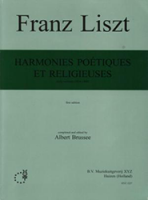
AB II-11
Description
Franz Liszt
HARMONIES POÉTIQUES ET RELIGIEUSES
EARLY VERSIONS (1833-1846)
completed and edited by
Albert Brussee

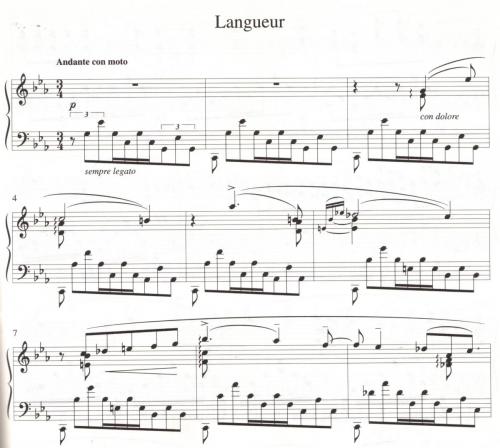
This volume contains all the piano pieces from the first phase of the genesis of the Harmonies poétiques et religieuses cycle. At first, the keyboard piece of that name is presented, which came into being in the summer of 1833, the time when the young composer was deeply in love with Marie d’Agoult, dwelling between despair and sweet dreams. The first version of Hymne de l’enfant à son réveil follows, composed on 8 October 1840 and inspired by Lamartine’s poem of the same name as well as by his own children, who, perhaps, he had on his lap when sketching this childlike-pious gem. However, the majority of the sketches, first published here, were created in the fall of 1845, shortly after the definitive break with Marie d’Agoult. The compositions, including very beautiful ones, were taken from Sketchbook N5. After a Prélude, which features the theme that was later included as the middle part in the beautiful Bénédiction de Dieu dance la solitude, the passionate Langueur is published, the no less beautiful Bei der Musik des Prinzen L (ouis) F (erdinand) and one of the the longest keyboard pieces that Liszt ever wrote: Dernière Illusion, in which the composer tried to cope with the break with Marie d’Agoult. Then follows Attente, the word from the first sentence of The First Letter from Paul to the Corinthians, which encouraged the inhabitants of that city (“Be vigilant, stand firm in faith, be manly, be strong.”). After the first version of Litanies de Marie, the work that in its second version forms one of the highlights of the 1847 version of the cycle (AB II-09), two reconstructions of the unfinished M.K. (Maria Kalergis) are included in the Appendix.
CONTENTS
Preface by Serge Gut (French/English)
Introduction
– Harmonies poétiques et religieuses (1834)
– Hymne de l’enfant à son réveil (first version, 1840)
– Prélude
– Langeur (1845)
– Bei der Musik des Prinzen L.F. (1845)
– Dernière Illusion (1845)
– Attente (1845)
– Litanies de Marie (first version, 1846?)
Appendix
– M.K. (1846), reconstructed by Albert Brussee
– M.K. (1846), reconstructed by Joop Celis
Editorial Policy / Critical Commentary
REVIEWS
“Albert Brussee is rounding off his project concerning Liszt’s Harmonies poétiques et réligieuses with the publication of nine ‘early versions’. (…) The book includes, in addition to a most comprehensive introduction and justification, a foreword by the well-known French Liszt expert Serge Gut. (…) That these earlier versions constitute legitimate entities in their own right, also from an artistic point of view, was demonstrated when, in 2000, during the Liszt Festival in Amsterdam, Brussee premièred the works, this in addition to his CD of them. Knowing Brussee, he will have transcribed Liszt’s manuscripts with scientific meticulousness. The publishers XYZ have thereupon issued the music as a beautiful, easily readable score. The book numbers 94 pages. Brussee’s work is invaluable for Liszt research if only for the insight it allows us into the compositional process. Just as valuable, however, is the fact that all of this provides a fascinating addition to the known Liszt repertoire.”
Christo Lelie, Piano Bulletin 2003-1. (Translated from the Dutch)
“Albert Brussee, Dutch pianist and musicologist, has spent a good ten years of his life researching and reconstructing the tortuous evolution of Liszt’s Harmonies poétiques et religieuses. After having edited the cycle of 1847 (eleven pieces) in 1997, he now comes to the fore with nine so-called ‘early versions’ from the years 1840-1846. Of these nine, eight are published here for the first time, three of them early drafts and the remaining five original compositions. Of those five, the most striking and extensive is undoubtedly Dernière Illusion, lasting all of 20 minutes; fascinating for Liszt-scholars to discover implicit in it the theme of his first Ballade or the Master’s visionary Bénédiction de Dieu dans la Solitude in the guise of the Prélude (Nancy, 1845). (…) The publication is a monument to Brussee’s musicological thoroughness and perseverance in leaving no stone unturned in his pursuit of the cycle – an advocacy which extends far beyond the mere notes on the page, challenging as these are, and extends to bringing them personally to life on the keyboard in the course of the many performances he has given of them across Europe.”
Malcolm Troup, Piano Journal Nr. 73 (Spring 2004).
PRACTICAL INFORMATION
© 2001 B.V. Muziekuitgeverij XYZ, Huizen, The Netherlands, XYZ 1227.
Full-colour cover; 94 pages.
Only a few copies left; the edition will not be reprinted as XYZ no longer exists.
€39.95
This volume comprises all the piano works from the first phase of the genesis of the cycle Harmonies poétiques et religieuses. First of all the piano piece of that name from 1833. Then the first version of Hymne de l’enfant à son réveil, inspired by the homonymous poem by Lamartine. However, the majority of the pieces, published here for the first time, came into being in the autumn of 1845, shortly after the definitive break with Marie d’Agoult.
Related products
-
Read moreMORE INFO
AB II-10
This edition comprises Nos. 7, 8, 9, 10 and 12 of the early version of the the cycle Harmonies poétiques et religieuses (1847) by Franz Liszt, published for the first time in 1997 by the Dutch Publishing House XYZ in two volumes. With a Foreword by Peter Scholcz, chairman of the Dutch Franz Liszt Kring, an illustrated Introduction and detailed ‘Critical notes and some suggestions for performance’.
-
Add to cartMORE INFO
AB II-22
€19.95Frédéric Chopin wrote his Introduction et Polonaise brillante for cello and piano, Opus 3, in 1829-30. When exactly Carl Czerny made a transcription for solo piano is not known, but the plate number of the first edition, published by Pietro Mechetti in Vienna, points to the end of the 1830s. In France in particular, this arrangement has been considered for decades as being written by Chopin himself.
-
![]() Add to cartMORE INFO
Add to cartMORE INFOAB II-24
€17.50When I for the first time did research in the Goethe- und Schiller-Archiv in Weimar in 1986, I found a sketch that evidently had to do with the genesis of the Mazeppa study. The sketch was written on two pages. Inserting these 20 bars in the early version of the Mazeppa study (1841) an intermediate version arises, the ‘missing link’ between that early version and the final one from 1851.
-
![]() Add to cartMORE INFO
Add to cartMORE INFOAB II-29
€15.00Valse pour Marie is the only composition by Franz Liszt that is certain to have been written on Dutch soil: the work was created in the days after his arrival in The Hague at the end of November 1842. The composition was never prepared for publication, the reason why after the Urtext – the notes as one finds them in the manuscript – a fully written-out and annotated version follows.

Reviews
There are no reviews yet.