Nederlands
Shop
Showing 28–36 of 48 results
-
Add to cartMORE INFO
AB II-20
€7.50This keyboard arrangement of Bernstein’s ‘Maria’ from the musical West Side Story stands midway between a literal transcription and a free fantasy (paraphrase). First one hears the theme based on the sensual rocking rhythm of the habanera, as given by Bernstein. Quasi-improvising, moving a little further away from the original, the theme is then spun around with typical pianistic accompaniment figures. A music example can be heard at AB I-06.
-
![]() Add to cartMORE INFO
Add to cartMORE INFOAB II-21
€7.50The well-known Poème by Fibich is best known in the arrangement for violin and piano by the famous violinist Jan Kubelik; the original keyboard piece is rarely heard anymore, possibly because it is only ten bars long. The current arrangement first presents the keyboard piece in its original setting. Then the theme is repeated in a varied way. Thus I have tried to give this composition a bit more ‘volume’ and to make it suitable for performance on stage.
-
Add to cartMORE INFO
AB II-22
€19.95Frédéric Chopin wrote his Introduction et Polonaise brillante for cello and piano, Opus 3, in 1829-30. When exactly Carl Czerny made a transcription for solo piano is not known, but the plate number of the first edition, published by Pietro Mechetti in Vienna, points to the end of the 1830s. In France in particular, this arrangement has been considered for decades as being written by Chopin himself.
-
![]() Add to cartMORE INFO
Add to cartMORE INFOAB II-23
€11.95In the Music Section of The Liszt Society Journal (Volume 41; 2016) some unknown, largely unpublished songs by Franz Liszt were published, including Göttliche Gedanken. Playing through the score, it all sounded so well on the piano that soon the thought surfaced that the musical material would also come into its own as a keyboard piece. After an initial literal transcription, I have allowed myself greater liberties.
-
![]() Add to cartMORE INFO
Add to cartMORE INFOAB II-24
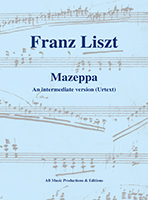
€17.50When I for the first time did research in the Goethe- und Schiller-Archiv in Weimar in 1986, I found a sketch that evidently had to do with the genesis of the Mazeppa study. The sketch was written on two pages. Inserting these 20 bars in the early version of the Mazeppa study (1841) an intermediate version arises, the ‘missing link’ between that early version and the final one from 1851.
-
![]() Add to cartMORE INFO
Add to cartMORE INFOAB II-25
€7.50On 7 November 2019, pianist and piano pedagogue Janine Dispa-van Mever passed away at the age of ninety. I came to know her as an excellent teacher, who helped me to largely overcome the professional disease focal dystonia that cast a shadow over my career as a pianist. The funeral card contained a beautiful poem, the Herbstlied by Siegfried August Mahlmann. Inspired by the comforting words of this poem this song came into being in the winter of 2019–20.
-
![]() Add to cartMORE INFO
Add to cartMORE INFOAB II-26
€24.95The Little Mermaid is based on the well-known fairy tale by Hans Christian Andersen. The seven-part cycle is completely symmetrical in structure. The total playing time is approx. 30 minutes; with a few exceptions the parts merge into each other. The harmonic language is that of the 19th century, but a certain influence from older musicals and film scores from the 1940s, 1950s and 1960s is demonstrable.
-
Add to cartMORE INFO
AB II-27
€19.95The Fantasy on Themes from the Opera Mazeppa by Clémence de Grandval, a French late-romantic composer, is a concert paraphrase of the kind that used to be written often in the 19th century. The opera itself may never be brought to the limelight again, but the score contains many a beautiful moment and I have tried to rescue these from oblivion in the form of a keyboard fantasia.
-
![]() Add to cartMORE INFO
Add to cartMORE INFOAB II-28
€24.95This fantasy on themes from Massenet’s opera Thaïs broadly follows the action. The instrumental section from the first act, in which Massenet paints the Roman city Alexandria as it stretches along the Mediterranean, is followed by the well-known Méditation de Thaïs and sections of the ballet music from the second act. From the third act are derived the beautiful love duet and the repetition of the Méditation, now, however, developed more dramatically.